

Church Bookkeeping Tips for Accurate Financial Records
Accurate financial records are essential for every church, regardless of its size or budget. Proper bookkeeping helps church leaders track donations, manage expenses, prepare financial reports, and maintain transparency with members.
When the money is provided by various sources and the money is spent on salaries, ministries, events and community programs, it may be difficult to manage church finances. Following a few practical bookkeeping tips can make financial management easier and enhance accountability.
The following are nine tips to good church bookkeeping that can assist your organization to keep good financial records.
Separate Church and Personal Finances
Never use personal money to pay church bills. Open a special bank account under the name of the church and use it to carry out all official transactions.
If staff members pay for approved church expenses personally, reimburse them through a documented process. Avoid mixing personal purchases with church funds.
Separating finances simplifies the process of tracking transactions, financial reporting and minimizes confusion in the audit process. It also shows good financial management to the members of the church.
Record Every Donation Accurately
Donations are a primary source of income for many churches. Documenting all the contributions properly assists in keeping reliable financial records.
Monitor cash contributions, checks, online contributions, recurring payments, and fundraising receivables. Record the date, amount, payment method, and designated purpose of each contribution.
As much as possible, two authorized persons should count cash offerings and reconcile the totals with deposit records. Keep safe records of donors and issue contribution statements where necessary.
Proper tracking of donations assists churches in responding to donor inquiries, preparing reports and handling contributions in a responsible manner.
Use Church Accounting Software
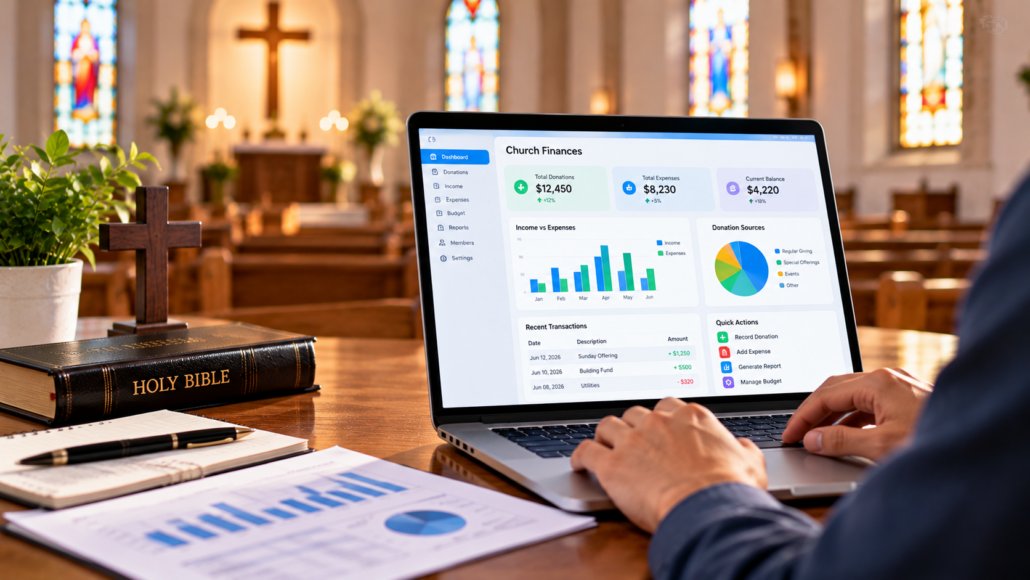
Manual bookkeeping can become difficult as a church grows. Church accounting software helps organize transactions, track donations, manage expenses, and generate financial reports.
Select software that suits your church size, budget and accounting requirements. The ability to track funds, monitor budgets, secure access, and automatic reporting are features that can save time and minimize errors.
For smaller churches, a well-structured spreadsheet can be used in the beginning. Nevertheless, accounting software that is specifically designed can be more organized with the growth of financial activity.
Track Income and Expenses Consistently
Note all the financial transactions as soon as possible and place them under the appropriate category. The typical sources of income are tithes, offering, grants, and fundraising.
Some of the expenses might be salaries, utilities, building maintenance, ministry supplies, insurance and community outreach.
Make financial reports more comprehensible by using similar categories. Retain receipts, invoices, reimbursement forms, and other supporting documents of all expenses.
Recording of transactions on a regular basis helps to avoid information being missed and simplifies monthly and annual reporting.
Create a Realistic Church Budget
A church budget helps leaders allocate resources according to the organization’s mission and priorities.
Start by going through past financial statements, estimating the amount of donations to be expected, and determining the necessary costs. Encompass staff compensation, ministry activities, maintenance, outreach programs, and emergency reserves.
Get church leadership to review and approve the budget prior to the start of the financial year. Compare actual income and expenses with budgeted amounts on a monthly basis.
Budget reviews are conducted regularly to determine whether the budget is being overused and enable leaders to make informed changes when the donations are lower or when there are unforeseen expenses.
Reconcile Bank Accounts Monthly
Bank reconciliation is the process of comparing accounting records and bank statements to ensure that there is a match.
Check deposits, payments, bank fees, outstanding checks, and electronic transactions on a monthly basis. Explore discrepancies as soon as possible instead of turning a blind eye to unexplained balances.
Whenever possible, assign reconciliation to an individual not involved in daily cash collections or payment approvals. In case of staffing shortage, have an independent review by a member of the treasurer or finance committee.
Periodic reconciliation can be used to detect recording errors, duplicates, missing transactions, and unauthorized payments.
Establish Strong Financial Controls

Internal financial controls safeguard church money and minimize the possibility of fraud and financial errors.
Develop written processes on how to receive donations, approving expenses, reimbursements, and payments. Establish spending limits and require additional approval for significant purchases.
Payment approval, bookkeeping and bank reconciliation: Separate duties whenever feasible. Restrict access to accounting systems to authorized users and audit financial operations.
Well-defined processes foster responsibility and can safeguard church resources.
Prepare Regular Financial Reports
Financial reports assist the leaders of the church to know the income, expenses, and the financial performance in general.
Prepare monthly reports of donations, operating costs, budget differences, available cash and fund balances. Keep it simple language so that pastors, board members, and finance committees can comprehend the information.
Track limited donations independently of money that can be used to meet general expenses. Donations to be used in particular projects must be used and accounted as per the restrictions of the donors and other requirements.
Frequent reporting helps to make better decisions, enhance transparency, and build trust among the congregation.
Maintain Organized Financial Records
Maintain bank statements, donation records, invoices, receipts, payroll records, contracts, and financial reports in a safe and orderly fashion.
Digital recordkeeping has the potential to enhance accessibility and minimize paperwork. Secure electronic documents through proper access controls and frequent backups.
Develop a document retention policy in line with relevant legal and tax regulations. Periodically review bookkeeping processes and seek advice of a qualified accountant where required particularly in payroll, tax returns and complicated transactions.
Organized records make financial reviews easier and help churches respond efficiently to questions or audits.
Building Financial Transparency in Your Church
Proper church accounting facilitates financial transparency, accountability and long-term sustainability. Churches can keep good financial records by tracking donations, recording expenses, reconciling bank accounts, and preparing regular reports.
These nine tips on bookkeeping can help minimize mistakes, enhance financial management, and make sure that church funds are used wisely. Having standard procedures and systematized records, the church leaders can be more assured about their mission and service to the community.

