
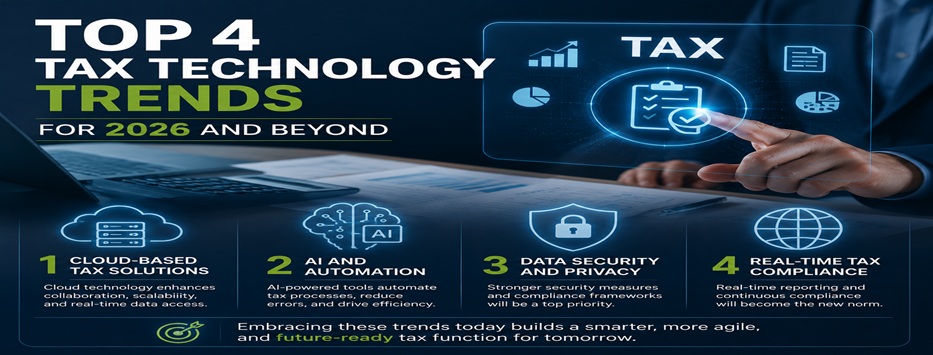
Top 4 Tax Technology Trends for 2026 and Beyond
The use of intelligent digital solutions by businesses, tax professionals, and governments is changing the face of tax technology significantly. Automation, artificial intelligence, real-time reporting, and advanced analytics are replacing traditional tax processes that were highly manual, relied on spreadsheets, and disconnected systems.
With the growing complexity of tax regulations and the growth of global operations, organizations require technology that enhances accuracy, diminishes compliance risks, and maximizes efficiency. Tax technology will keep on developing in 2026, and beyond, as a strategic business tool as opposed to a compliance role.
By adopting new trends in tax technology, companies will be in a better position to deal with changes in regulations, enhance decision-making, and develop more efficient tax processes. The following are the four best tax technology trends that are likely to influence the future of taxation.
Artificial Intelligence and Machine Learning in Tax Operations

One of the most powerful technologies in the tax sector is artificial intelligence (AI). AI-based tools are becoming more popular with tax departments in processing large volumes of financial data, detecting possible errors, and automating repetitive processes.
Machine learning algorithms are capable of processing transaction records, identifying suspicious patterns, and assisting businesses in identifying tax risks prior to turning into compliance issues. These technologies enable tax professionals to have less time on manual data review and more time on strategic tax planning.
The AI-based tax solutions can help with:
- Classification of tax documents
- Analysis of expenses and transactions
- Tax research assistance
- Compliance monitoring
- Risk detection and reporting
In addition to automation, AI is also enhancing tax forecasting. Predictive analytics help businesses to know future taxes and financial conditions, so they can make superior decisions. With the advancement of AI technology, tax teams will turn to more intelligent systems as digital assistants that will aid in making complicated tax decisions.
Increased Use of Tax Automation and Cloud-Based Platforms
Tax automation will further grow as organizations seek means of enhancing accuracy and efficiency. The manual tax processes tend to cause delays and the likelihood of human errors, particularly when dealing with companies that have multiple locations, jurisdictions, or tax regimes.
Tax platforms on the cloud offer businesses a centralized platform where financial data, compliance data, and reporting tools can be managed better. These solutions enable the tax teams to have access to updated information in real time and work more easily across departments.
The automation of taxes can be used to facilitate:
- Calculations and filing of taxes
- Data validation and collection
- Compliance reporting
- Audit preparation
- Regulatory updates
Cloud technology also offers scalability, which enables businesses to adapt their tax systems with the expansion. Companies do not need to spend a lot of money on the traditional infrastructure; they can rely on flexible cloud solutions that can be updated automatically and that help to adjust to the changing business needs.
To tax professionals, cloud-based solutions provide a more interconnected world in which finance, accounting, and tax functions can collaborate with greater visibility.
Real-Time Tax Reporting and Digital Compliance
Governments are shifting towards real-time tax reporting systems to enhance transparency and minimize tax fraud. This change is transforming the way business is handled in terms of compliance and reporting of financial information.
Previously, most companies used to prepare tax reports on a periodic basis, usually after financial periods were over. Nonetheless, digital tax systems can now enable tax authorities to collect and analyze transaction information much faster.
Real-time tax reporting demands that businesses keep proper, interrelated, and available financial information. Businesses will require technology solutions, which will be able to automatically record transactions, implement appropriate tax regulations, and produce compliant reports.
The main advantages of real-time tax technology are:
- Faster compliance reporting
- Reduced risk of penalties
- Improved data accuracy
- Greater transparency of financial operations
With the ongoing growth of digital tax regulations, companies will require sophisticated tax technology solutions that will be able to meet various reporting requirements in a multitude of regions. Tax departments will be more likely to become data-driven teams that apply technology to ensure compliance proactively rather than reacting to problems once they arise.
Advanced Data Analytics and Predictive Tax Insights
Data analytics is emerging as an important element of contemporary tax management. Companies produce massive volumes of financial data, and sophisticated analytics solutions can be used to convert this data into insights.
Analytics features of tax technology platforms can be used to detect trends, assess risks, and aid in strategic planning. Businesses can use data to see the effects of tax decisions on overall financial performance, instead of merely computing tax obligations.
Predictive analytics can help organizations:
- Forecast future tax liabilities
- Identify compliance risks
- Optimize tax strategies
- Evaluate business expansion decisions
- Improve financial planning
Indicatively, analytics tools can be used by companies entering new markets to assess the potential tax implications of their investments before investing. This enables businesses to make better decisions and minimize unforeseen tax issues.
With the advancement of analytics technology, tax professionals will cease to be mere compliance agents and become valuable advisors, who assist in shaping business strategies.
The Future of Tax Technology: A More Intelligent and Connected Approach
Automation, intelligence, and integration will become the future of tax technology. Businesses will not perceive tax systems as independent instruments that are applied only at the time of filing. Rather, tax technology will be a vital component of daily financial processes.
The combination of artificial intelligence, cloud platforms, real-time reporting, and advanced analytics will help develop faster, more precise, and strategic tax processes. By investing in such technologies, organizations will be in a better position to address the evolving regulations and rising compliance requirements.
However, successful technology adoption requires more than simply implementing new software. Businesses need to also pay attention to data quality, training of employees, cybersecurity, and choosing solutions that can fit their needs.
