
Taxation of Restricted Stock Units: A Complete Guide for Understanding RSU Tax Rules
Restricted stock units (RSUs) are a recent trend in employee compensation, particularly among professionals in the technology sector, startups, and publicly traded companies. Although RSUs may be very beneficial financially, it is important to be aware of the taxation of restricted stock units to avoid any unforeseen tax payments to make a good financial choice.
RSUs, unlike conventional stock purchases, are subject to certain tax regulations that dictate when and how income is reported. To manage their RSU compensation efficiently, employees should be familiar with such concepts as vesting, ordinary income tax, capital gains, withholding requirements, and tax planning strategies.
What Are Restricted Stock Units (RSUs)?
Restricted stock units are a form of equity compensation in which an employer agrees to award employees shares of the company upon the fulfillment of some conditions, typically via a vesting schedule. Such conditions can be a stay with the company over a certain duration or performance targets.
Employees do not buy RSUs as they do with stock options. They are, instead, given shares when the units are vested. RSUs are not shares, but a promise of future stock ownership before they become vested.
As an illustration, an employer can award an employee 1,000 RSUs which will be vested in four years. Assuming that 25% of the RSUs are vested annually, the employee will get 250 shares annually upon satisfying the vesting conditions.
Understanding how RSUs work is the first step toward managing their tax impact effectively.
When Are RSUs Taxed?
The taxation of restricted stock units is usually at the point of vesting, rather than granting. The most important tax event is the date of vesting since it is the date when the employee obtains ownership rights to the shares.
The fair market value (FMV) of the shares is considered as ordinary income at the time of vesting. This is added to the wages of the employee and is subject to federal income tax, state income tax, Social Security tax and Medicare tax.
For example, in the case of 500 RSUs that are vested when the company stock price is $40 per share, the taxable income would be:
500 shares × $40 = $20,000
This $20,000 has to be reported as ordinary income by the employee during that tax year.
How RSU Taxation Works After Vesting
After RSUs have vested and the tax is paid on their value, the shares are converted into ordinary stock owned by the employee. Any subsequent growth or decline in the stock price is handled differently in terms of tax.
If the employee sells the shares after the vesting, the amount of the difference between the selling price and the stock value on the vesting date is a capital gain or capital loss.
As an illustration, when RSU shares vested and were sold at a later date at a price of $55 per share, the extra $15 gain per share would be taxed as a capital gain.
The holding period will ascertain whether the gain will be short-term or long-term:
- Short term capital gains are applicable when the shares are sold within a year or less
- Long-term capital gains are applicable to shares held over a period of one year
Ordinary income is typically taxed at a higher rate than long-term capital gains.
Understanding RSU Tax Withholding
When RSUs are vested, employers automatically withhold taxes. The withholding process helps employees to pay their tax without making separate payments.
Typical withholding techniques are:
Sell-to-cover: The company sells part of the vested shares to pay the taxes, and the employee is given the rest of the shares.
Share withholding: The company retains sufficient shares to pay the necessary tax.
Cash payment: In certain situations, the employees can be required to pay some extra taxes separately.
The usual withholding rate might not necessarily address the actual tax liability of the employee, particularly to high-income earners. So employees are advised to look at their total tax position to find out whether they have to make any extra estimated tax payments.
Federal and State Tax Considerations for RSUs
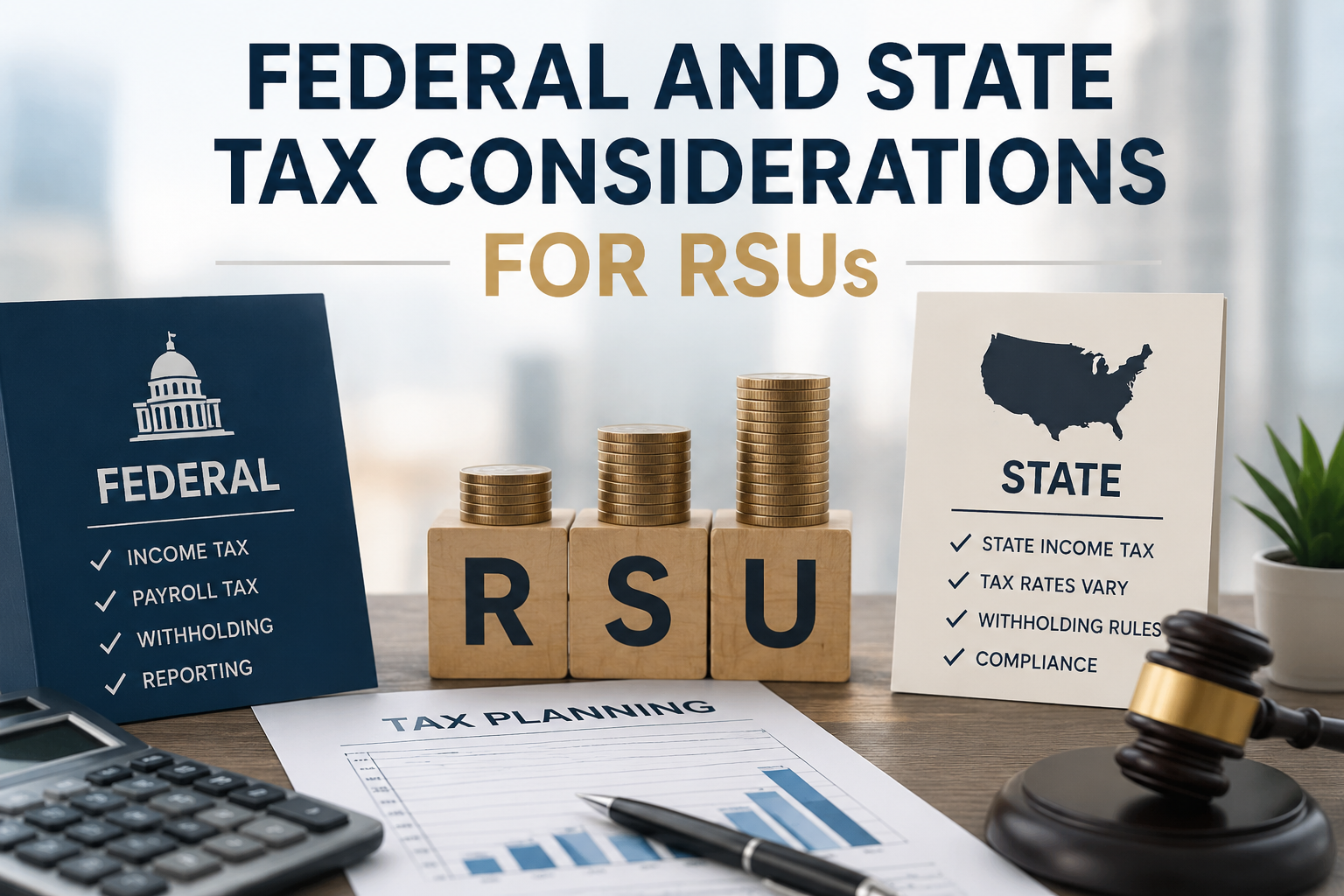
The taxation of RSU is determined by federal and state taxation laws, which may differ greatly depending on the location of the worker.
Federal taxation of vested RSUs is typically shown as ordinary income. The tax rate is based on the amount of taxable income and tax bracket of the employee.
State taxation may add more complexity. RSU income is taxed differently in some states, especially where employees relocate between states during the vesting period.
International employees or those who may be relocating are advised to be aware of the tax residency regulations since RSUs can give rise to reporting requirements in various jurisdictions.
Common RSU Tax Mistakes to Avoid
There are numerous errors that employees commit when dealing with limited stock units. A typical mistake is not to plan taxes upon vesting. The shares received as company stock may seem like a financial gain, but the tax liability is present even in the absence of selling the shares.
The other error is to have excess company stock. RSUs are employer-related, which means that having a significant part of wealth in company shares may cause unnecessary investment risk.
Employees also need not assume that their payroll withholding fully covers their tax liability. An overview of the income, deductions, and tax brackets can assist in avoiding any unexpected tax bills.
Strategies for Managing RSU Tax Liability
Proper RSU tax planning may assist employees in minimizing risks so they can make the most of their equity compensation.
One of the approaches is selling shares following the vesting in order to diversify investments and not be overly exposed to the stock of one company. Employees can also take into consideration timing sales in accordance to their financial objectives and possible capital gains treatment.
Another step is to track the cost basis of RSU shares. The cost basis to calculate future capital gains or losses is the fair market value on the vesting date.
It can be a good idea to hire a tax professional or financial advisor, particularly when employees have substantial RSU grants, international tax issues, or complicated investment scenarios.

