
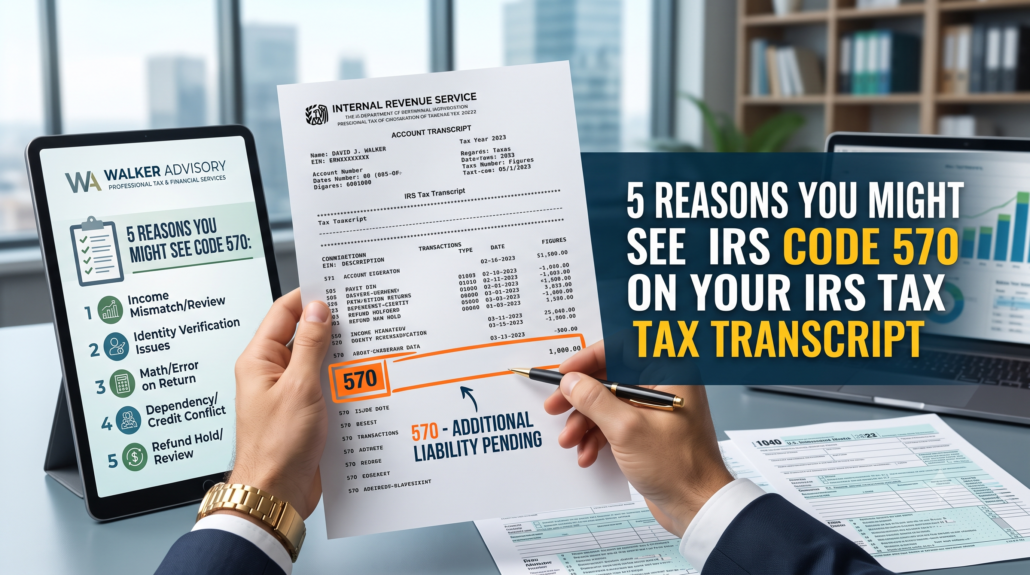
5 Reasons You Might See IRS Code 570 on Your IRS Tax Transcript
Seeing IRS Code 570 on your tax transcript can be confusing, especially if you are waiting for a tax refund. Transaction Code 570 generally means that the IRS has placed a hold on your account because additional tax liability may be pending or because your account requires further processing.
The emergence of the code 570 does not necessarily mean that you must pay extra taxes. It may come during the time the IRS is reviewing information, verifying your tax return, resolving an account problem, or deciding whether a refund will be issued.
The tax transcript has transaction codes that indicate various activities in your IRS account. Knowing what these codes are, the dates, and other transactions that appear on your transcript can help you know why your refund may take a long time.
Here are five common reasons you might see IRS Code 570 on your tax transcript.
1. The IRS is Reviewing Your Tax Return
The most frequent explanation of the appearance of IRS Code 570 is that the IRS requires more time to examine your tax return. The IRS can hold your refund pending verification or whether an adjustment is required.
This review does not necessarily mean that you made a mistake on your tax return. There are many reasons tax returns may need to undergo further processing, such as the presence of information that must be compared to the records that the IRS has.
As an illustration, when the information you reported on your tax return is not immediately consistent with information in IRS records, the agency might require more time to examine your account. In the process, your transcript can indicate Code 570, although the IRS has not yet decided that you owe them more tax.
Therefore, seeing Code 570 should not immediately cause concern. It often means that the IRS has not completed its review of your account.
2. The IRS is Checking Your Income or Tax Information
Another cause of IRS Transcript Code 570 can be a discrepancy in terms of income, tax withholding, credits, or other information you have reported on your tax return.
Employers, financial institutions, and other organizations provide the IRS with tax information. This must match the information you reported on your tax return. If something is not similar or needs to be verified, your return might need further examination.
For example, the IRS might require checking data concerning wages, federal income tax withholding, or some tax credits. As this review is being done, your refund might be held.
An IRS notice is also something to look out for. If the IRS requires documents or other information of yours, the notice must provide what is required and how to respond.
3. An Additional Tax Liability May Be Pending

The simplest reason why IRS Code 570 could be on your account is that there is another tax liability pending to be charged.
The IRS may place a hold on a credit or refund when it has determined that there is a problem that may lead to the imposition of extra tax. The hold provides the IRS with time to decide on the adjustment of the account.
But Code 570 alone does not mean you have to pay extra money. It is merely a sign that further processing or adjustment of an account may be required.
You should check the transactions of Code 570 to know what might have caused the hold. When a change leads to the assessment of an extra tax, a second transaction can be shown on your transcript to represent the change.
This is why you must not think that you are permanently denied your refund just because you are seeing Code 570. The code is, in most cases, a transitional stage in the IRS processing system.
4. A Credit or Payment on Your Account Requires Review
Code 570 may also be used when you have a credit or payment on your IRS account that is not yet available to be released as a refund.
The account might require further scrutiny when the IRS is paid or a tax credit is processed before the money can be refunded or used in other ways. A credit freeze may be maintained until the IRS decides the way the amount should be treated.
As an example, your account might reflect a credit due to tax withholding, estimated tax payments, or other payments made on your tax liability. Code 570 might be listed on your transcript if the IRS requires verifying the account prior to issuing that credit.
This is the other reason why it is important to look at the transcript as a whole. Note the dates, amounts, and transaction codes that come before and after Code 570.
The data in the code can give hints to the reason of the hold and whether the IRS has done more on your account.
5. The IRS Needs to Correct or Resolve an Account Issue
A fifth reason you might see IRS Code 570 on your tax transcript is that the IRS needs to correct or resolve an issue with your account before releasing a refund.
The IRS can subsequently add another transaction which alters the status of the hold. An example of this is that Code 571 typically means that a former Code 570 freeze has been undone. In other cases, Code 572 can mean that Code 570 was done incorrectly and is being amended.
This implies that your tax account may not always end up in Code 570. Your transcript may alter as the IRS finishes its audit and handles more transactions.
When you are waiting to get a tax refund and you see Code 570, you should periodically check your transcript to see new activity. You also need to look at any letter that the IRS has sent and act on it as soon as possible in case they want you to provide more information.
What Should You Do If You See IRS Code 570?
If IRS Code 570 appears on your tax transcript, start by reviewing the complete account transcript for the applicable tax year. Look at the transactions immediately before and after Code 570, including the dates and amounts.
Also look to see whether you have been given an IRS notice. If the IRS requests documentation or further information, respond as per the instructions in the notice.
Above all, IRS Code 570 does not necessarily mean that you are not going to get your tax refund. It usually signifies that an account or credit operation is in suspension as further processing, check, or an adjustment occurs.
The hold can be released, and your tax account can proceed once the IRS has resolved the issue. Knowledge of the transaction codes around you can assist you in knowing whether the hold is temporary and what could occur next.
